Quartz
Quartz is one of the most versatile industrial minerals on Earth. With a hardness of 7 on the Mohs scale and exceptional chemical purity (SiO₂ up to 99.95%), our quartz products serve multiple industries including glass manufacturing, ceramics, electronics, and construction. Available in various grades from ordinary sand to high-purity powder for specialized applications.
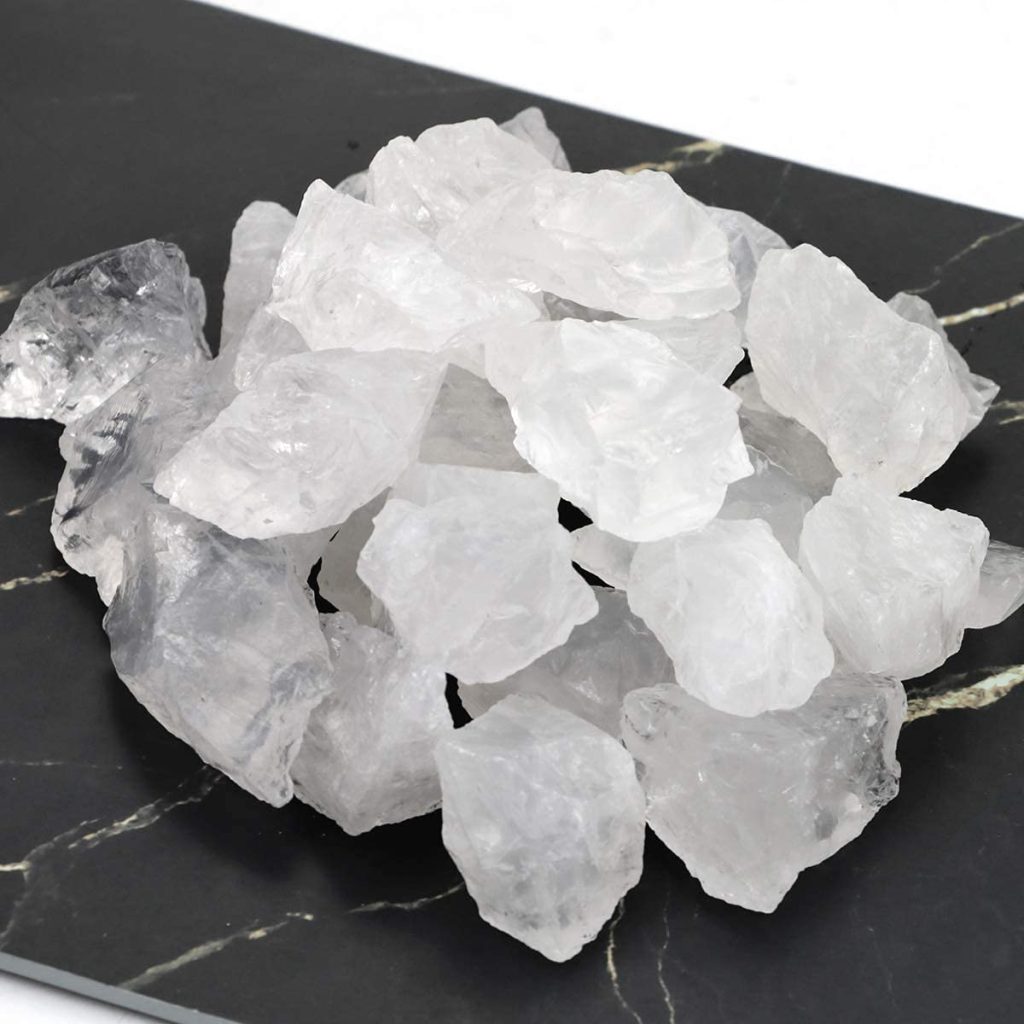
QUARTZ
Quartz (silicon dioxide – SiO₂) is the second most abundant mineral in the Earth’s continental crust, after feldspar. Its unique combination of hardness, chemical stability, and piezoelectric properties makes it indispensable for countless industrial applications.
At Earth Raw Materials, we offer a comprehensive range of Egyptian quartz products, sourced from high-purity deposits and processed to meet international standards. With our monthly supply capacity and strategic partnerships, we ensure reliable delivery to clients worldwide.
Grade Range & Specifications
Quartz products are classified based on SiO₂ purity, which determines their suitability for different applications:
Grade Purity (SiO₂) Industry Classification Key Applications.
Grade C – Ordinary 95% – 98% Low Grade Construction aggregate, concrete, mortar, road ballast.
Grade B – Medium 98% – 99.5% Medium Grade Glass manufacturing, ceramics, foundry molds, abrasives.
Grade A – High 99.5% – 99.9% High Purity (3N) Artificial quartz stone, refractory materials, fillers for paints & coatings.
Grade AA – Premium 99.9% – 99.99% High Purity (4N) Semiconductor crucibles, photovoltaic cells, optical glass, specialty ceramics.
Grade AAA – Ultra-Pure 99.99% Ultra-High Purity (4N8 – 5N) Optical fibers, UV-transparent lenses, laboratory ware, high-end electronics.
Note: Higher purity grades require specialized processing including magnetic separation, flotation, and acid leaching to remove trace impurities such as iron, aluminum, and titanium.
Applications by Industry
- GLASS INDUSTRY
Quartz sand is the primary raw material for glass manufacturing. The purity requirements vary by glass type:
- Container glass (bottles, jars): Grade B (98-99.5% SiO₂)
- Flat glass (windows, mirrors): Grade B to Grade A
- Optical glass (lenses, prisms): Grade AA to Grade AAA
- Laboratory glassware: Grade AA
- Fused quartz / silica glass: Grade AAA (for high-temperature applications)
- CERAMICS & REFRACTORIES
- Porcelain and tile manufacturing: Quartz provides strength and thermal stability
- Refractory bricks: High-temperature resistance up to 1650°C
- Ceramic glazes: Fine quartz powder (200-400 mesh) for glossy finishes
- ELECTRONICS & SEMICONDUCTORS
- Quartz crucibles: Used to hold molten silicon during crystal growth for semiconductor wafers.
- Piezoelectric devices: Quartz crystals oscillate at precise frequencies in watches, radios, and smartphones.
- Fiber optics: High-purity quartz transmits light signals with minimal loss.
- CONSTRUCTION & BUILDING MATERIALS
- Engineered quartz stone: Crushed quartz (90-95%) mixed with resin for kitchen countertops and vanity tops.
- Concrete aggregate: Ordinary grade quartz sand and gravel.
- Flooring and coatings: Quartz powder adds abrasion resistance to industrial floors.
- METALLURGY
- Flux in smelting: Quartz helps lower melting temperatures in metal production.
- Foundry molds: Quartz sand is used in casting molds due to its thermal stability.
- ABRASIVES & FILTRATION
- Sandblasting: Quartz sand for surface preparation and cleaning.
- Water filtration: High-purity quartz sand as filter media.
- Polishing compounds: Fine quartz powder for metal and stone polishing.
- PAINTS, COATINGS & FILLERS
- Industrial coatings: Quartz powder adds hardness and wear resistance.
- Fillers in plastics and rubber: Improves mechanical properties.
- Anti-slip coatings: Coarse quartz for textured surfaces.
Physical Forms Available
Form Particle Size Typical Applications:
- Quartz Sand 0.1 – 5 mm Glass manufacturing, construction, filtration.
- Crushed Quartz 5 – 50 mm Engineered stone, refractory materials.
- Quartz Powder – Coarse 100 – 500 μm Abrasives, foundry molds.
- Quartz Powder – Fine 40 – 100 μm Ceramics, paints, fillers.
- Quartz Powder – Microfine 1 – 40 μm High-end coatings, electronics.
- Ultra-Fine Powder < 10 μm Cosmetic applications, specialized fillers.
Chemical Analysis (Typical)
Note: Actual analysis varies by deposit and processing. Full Certificate of Analysis provided with each shipment. Lower iron content (Fe₂O₃) is critical for glass and ceramics to avoid discoloration.
Varieties by Color & Crystal Structure
Quartz occurs in several natural varieties based on color and crystal structure:
Variety Color Characteristics Typical Use.
- Rock Crystal: Colorless, clear Highest purity, transparent Optics, electronics, jewelry.
- Milky Quartz: White, cloudy Most common variety, fluid inclusions Industrial silica, glass, ceramics.
- Rose Quartz: Pink Trace elements (Ti, Mn) Jewelry, ornamental, metaphysical.
- Smoky Quartz: Brown to gray Natural irradiation Jewelry, decorative.
- Citrine Yellow: to orange Heat-treated or natural Gemstone, jewelry.
- Amethyst: Purple Iron impurities Gemstone, jewelry.
- Vein Quartz: White to translucent Hydrothermal origin High-purity applications after processing.
Note: For industrial applications, milky quartz and vein quartz are the most commonly used varieties due to their abundance and cost-effectiveness.
Quality Assurance & Processing
Our quartz products undergo rigorous quality control:
- Chemical analysis by XRF and ICP-MS for trace elements.
- Particle size distribution testing by laser diffraction.
- Magnetic separation to remove iron-bearing minerals.
- Acid leaching for high-purity grades to dissolve metallic impurities.
- Third-party inspection available upon request (SGS, Bureau Veritas)
Packaging & Loading
- Bulk: Direct loading into vessel holds.
- Jumbo Bags: 1.0 – 1.5 metric tons.
- Small Bags: 25kg, 50kg polypropylene bags.
- Custom Packaging: Available upon request.
| Chemical Analysis (Typical) | ||
|---|---|---|
| Remarks | Chemical analysis | |
| Result % | Element | |
| 99.60 | SiO2 | |
| 0.003 | TiO2 | |
| 0.024 | Al2O3 | |
| 0.007 | Fe2O3 | |
| 0.01 | MnO | |
| < 0.01 | MgO | |
| 0.10 | CaO | |
| < 0.01 | Na2O | |
| < 0.01 | K2O | |
| < 0.01 | P2O5 | |
| 0.12 | L.O.I | |