Kaolin
Egyptian Kaolin
Kaolin (hydrated aluminum silicate – Al₂Si₂O₅(OH)₄) is a soft, white clay mineral essential for ceramics, paper, paint, rubber, and refractories industries. Egypt has large kaolin reserves in three main areas: Sinai, the Red Sea coast, and the Aswan (Kalabsha) region, with total reserves estimated at over 100 million tons in Sinai alone. Our Egyptian kaolin ranges from 26% to 35% Al₂O₃, serving both local manufacturing and international markets with ongoing beneficiation projects to enhance purity for high-value applications.
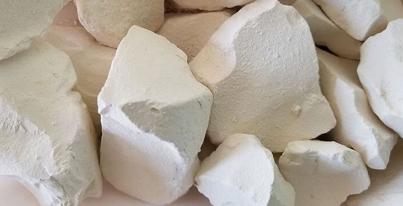
EGYPTIAN KAOLIN
What is Kaolin?
Kaolin, also called China clay, is a industrial clay mineral composed mainly of kaolinite. It is characterized by its fine, soft, and light-colored texture, with theoretical composition of approximately 39.5% Al₂O₃, 46.5% SiO₂, and 14% H₂O . Kaolin is valued for its chemical inertness, high covering power, and excellent firing properties.
Egyptian Deposits
Egypt possesses extensive kaolin deposits in three principal locations:
– Sinai: The most significant producer, with deposits at Mussaba Salama, El-Tih, Farsh El-Ghozlan, and other locations. Total reserves exceed 100 million tons with Al₂O₃ grades ranging from 26% to 35%. These deposits are of Carboniferous and Cretaceous ages.
– Red Sea Coast: Additional kaolin occurrences along the Red Sea, often associated with quartz and other minerals.
– Aswan (Kalabsha): Kaolinitic clays in Northeast Aswan, part of the Nubia Group formations (Abu Aggag, Timsah, and Umm Barmil). These deposits are being evaluated for refractory applications.
Recent government initiatives include a €90 million integrated industrial project in Ain Sokhna to maximize kaolin value addition, employing advanced technologies for physical, chemical, and thermal separation. Additionally, a tripartite agreement between Wadico, ASCOM, and ACCM aims to process Ras Ghareb kaolin to 2-micron particle size for global markets across 45 countries.
Industrial Applications
Egyptian kaolin serves multiple industries:
- Ceramics and Tiles: The largest consumer, using kaolin for wall tiles, floor tiles, sanitaryware, and porcelain. Properties required include plasticity, strength, and controlled fired color.
- Paper Industry: Used as filler and coating pigment to improve brightness, opacity, gloss, and ink receptivity. Coating grades typically require >75% particles below 2 microns.
- Refractories: High-alumina kaolin is used in refractory bricks and materials resistant to high temperatures. Aswan clays show promise for refractory applications based on physical properties like apparent porosity and bulk density.
- Paint and Coatings: As an extender and pigment, providing brightness and durability.
- Rubber and Plastics: As functional filler in PVC, cable coatings, and other polymer applications.
- White Portland Cement: Grade 3 kaolin (Al₂O₃ <30%) can be used in white cement manufacturing.
- Alum and Alumino-silicate Production: For chemical industries.
Quality and Beneficiation
Egyptian kaolin is often described as hard, massive, and low-grade, requiring beneficiation to meet international specifications for paper and ceramics. Key quality parameters include:
- Al₂O₃ content: Ranges from 26% to 35% in raw ore.
- Iron oxide (Fe₂O₃): Coloring impurity, typically 0.5-1.8% in paper coating grades.
- Titanium oxide (TiO₂): Coloring impurity, typically 0.04-1.6% in paper coating grades.
- Particle size: Critical for paper coating (>75% <2μm) vs. filler (>30% <2μm).
Beneficiation studies using magnetic separation have shown significant improvements:
- Reduction of Fe₂O₃ from 1.69% to 0.75%
- Reduction of TiO₂ from 3.1% to 0.71%
- Improvement in brightness from 63.76% to 75.21%
- Improvement in whiteness from 79.85% to 86.72%
Sinai Kaolin Grades
Studies on Sinai kaolin deposits indicate:
- Cretaceous kaolin: Higher grade with Al₂O₃/SiO₂ ratio averaging 0.54
- Carboniferous kaolin: Lower grade with Al₂O₃/SiO₂ ratio averaging 0.43
- Some high-grade lenses in Wadi Iseila show Si/Al molecular ratio near unity, indicating premium quality.
- Grade 3 kaolin: (Al₂O₃ <30%) suitable for white cement and red glaze manufacturing.
Radiological Considerations
Some Carboniferous kaolin deposits in Sinai show elevated radioactivity levels due to uranium and thorium content, which can be an impediment for certain applications or export. However, Cretaceous deposits generally have lower radioactivity and are preferred for sensitive applications.
Current Developments
Egypt is actively pursuing kaolin value addition through:
- The INCOM Egypt project in Ain Sokhna (€90 million investment) for advanced kaolin processing
- The Wadico-ASCOM-ACCM partnership for 2-micron processing in Minya, targeting 45+ countries
- Ongoing research at CMRDI and Egyptian universities on flotation and magnetic separation
Physical Forms Available
- Lumps: Run-of-mine, crushed and sized.
- Powder: Various mesh sizes for direct industrial use.
- Beneficiated products: Processed for specific applications (paper coating, ceramics).
Packaging Options
- Jumbo Bags: 1.0 – 1.5 metric tons.
- Small Bags: 25kg, 50kg.
- Bulk: Available for large industrial consumers
Quality Assurance
Each shipment is accompanied by:
- Certificate of Analysis from accredited laboratories.
- Al₂O₃ content verification.
- Fe₂O₃ and TiO₂ analysis.
- Particle size distribution.
- Brightness/whiteness testing.
- Third-party inspection available upon request
Quick Summary:
Egyptian kaolin is found in abundance across Sinai (100+ million tons), the Red Sea coast, and Aswan. While our raw kaolin ranges from 26-35% Al₂O₃ and requires beneficiation for premium applications, modern processing facilities—including the new €90 million Ain Sokhna complex and partnerships for 2-micron refining—are unlocking its full potential. We supply various grades for ceramics, paper, paint, rubber, and refractories, backed by Egypt’s strategic location for export to global markets.
| Chemical Analysis (Typical Specifications) | ||
|---|---|---|
| Pisolitic Caolinite | ||
| Remarks | Chemical analysis | |
| Result % | Element | |
| 50.5 | SiO2 | |
| 31.2 | Al2O3 | |
| 1.89 | Fe2O3 | |
| 13.3 | L.O.I | |
| 2.0 | CaO | |
| 0.6 | MgO | |
| 1.1 | TiO2 | |
| 0.3 | Na2O | |
| 0.1 | K2O | |
| Remarks | Chemical analysis |
|---|---|
| Result % | Element |
| 29.94 | Al2O3 |
| 0.25 | Fe2O3 |
| 56.00 | SiO2 |
| 1.12 | CaO |
| Nil | K2O |
| 0.33 | Na2O |
| 0.45 | TiO2 |
| 3.59 | CO2 |
| 1.5 | SO3 |
| 0.03 | Cl |
| 0.02 | Mn2O3 |
| 0.3 | MgO |
| 0.12 | P2O5 |
| 11.58 | L.O.I |
| 6.99 | O . M . |