Feldspar
Feldspar is the most abundant group of minerals in Earth’s crust, making up over 50% of it. As an essential fluxing agent in ceramics and glass manufacturing, it lowers melting temperatures and enhances product durability. Our Egyptian feldspar is available in both sodium and potassium types, processed to meet international standards with controlled iron content for optimal whiteness and performance.
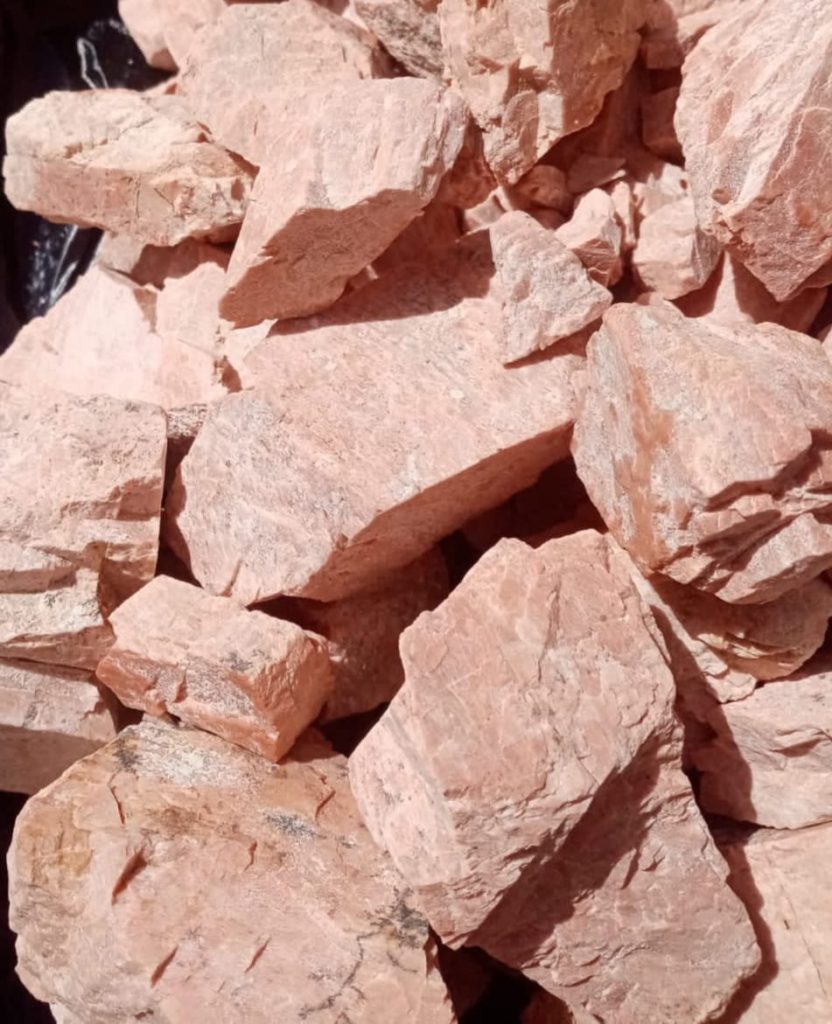
Feldspar
Feldspar is the most abundant group of minerals in Earth’s crust, making up over 50% of it. As an essential fluxing agent in ceramics and glass manufacturing, it lowers melting temperatures and enhances product durability. Our Egyptian feldspar is available in both sodium and potassium types, processed to meet international standards with controlled iron content for optimal whiteness and performance.
FELDSPAR
Feldspar is not a single mineral but a family of closely related aluminosilicate minerals that make up more than half of the Earth’s continental crust. They are found in igneous, metamorphic, and sedimentary rocks worldwide. The three primary types—sodium feldspar (albite), potassium feldspar (orthoclase), and calcium feldspar (anorthite)—differ in their alkali composition but share similar crystal structures and properties.
At Earth Raw Materials, we offer high-quality Egyptian feldspar, processed to meet the demanding requirements of the ceramics, glass, and filler industries. With our monthly supply capacity and strategic partnerships, we ensure reliable delivery to clients worldwide.
What Makes Feldspar Essential?
Feldspar is valued in industry for two key functions:
Function Description
Fluxing Agent The alkalis (sodium and potassium) in feldspar lower the melting temperature of ceramic and glass mixtures, reducing energy costs and aiding vitrification.
Alumina Source Provides alumina (Al₂O₃) which enhances mechanical strength, chemical durability, and thermal stability of finished products.
Types of Feldspar
Based on the dominant alkali element, feldspar is classified into two main commercial types:
Type Chemical Formula Key Characteristics Typical Applications
- Soda Feldspar (Albite) Na₂O·Al₂O₃·6SiO₂ High sodium content, lower melting point, excellent fluxing properties Ceramic tiles, sanitaryware, tableware, glass manufacturing.
- Potash Feldspar (Orthoclase/Microcline) K₂O·Al₂O₃·6SiO₂ Higher potassium, wider firing range, better mechanical strength Porcelain, electrical insulators, high-strength ceramics.
Note: Natural feldspar often contains a mix of both sodium and potassium, along with minor calcium.
Grade Range & Specifications
Feldspar products are classified based on alkali content (Na₂O + K₂O) and iron oxide (Fe₂O₃) content, which affects whiteness and quality :
Grade Na₂O % K₂O % Fe₂O₃ % (max) SiO₂ % Al₂O₃ % Key Applications
- Soda Feldspar – Standard 8-10% 2-4% < 0.15% 68-72% 16-18% Wall tiles, floor tiles, container glass.
- Soda Feldspar – Premium 9-11% 3-5% < 0.08% 67-70% 17-19% Sanitaryware, tableware, glazes.
- Potash Feldspar – Standard 2-4% 8-11% < 0.15% 65-68% 17-19% Porcelain, electrical ceramics.
- Potash Feldspar – Premium 2-3% 10-12% < 0.08% 64-67% 18-20% High-voltage insulators, dental ceramics.
- Feldspathic Sand 3-5% 3-5% < 0.20% 75-80% 8-12% Fiberglass, glass containers.
Note: Lower iron content (Fe₂O₃) is critical for achieving whiteness in ceramics and clarity in glass. Iron impurities can occur as micro-inclusions or within the crystal lattice, making removal challenging.
Applications by Industry
- CERAMIC INDUSTRY
Feldspar is an essential component in all ceramic bodies and glazes:
Application Function Typical Grade
- Wall & Floor Tiles: Flux to reduce firing temperature, improve densification Soda feldspar, standard grade.
- Sanitary-ware: Enhances vitrification, strength, and surface finish Soda feldspar, premium grade.
- Tableware & Porcelain: Provides translucency, mechanical strength, and whiteness Potash feldspar.
- Ceramic Glazes: Lowers melting point, improves gloss and durability Fine powder (soda or potash)
- Electrical Insulators: High mechanical strength and dielectric properties Potash feldspar, low iron.
- GLASS INDUSTRY
Feldspar is a critical raw material in glass manufacturing, serving multiple functions:
Glass Type Function Benefits
- Container Glass: (bottles, jars) Alumina source, flux Improves chemical durability, lowers melting temperature.
- Flat Glass: (windows, mirrors) Stabilizer Enhances weatherability and mechanical strength.
- Fiberglass: Flux and alumina source Impro tensile strength and chemical resistance.
- Optical Glass: High-purity alumina source Enhances clarity and refractive properties.
- TV Screens & Displays: Controlled melting properties Essential for LCD, OLED, and touchscreen glass.
- FILLERS & EXTENDERS
Feldspar is used as a functional filler in various industries:
Industry Application Benefits
- Paints & Coatings: Extender pigment Burnish resistance, ease of tinting, gloss control, scrub resistance.
- Plastics & Rubber: Functional filler Improves mechanical properties, reduces production costs.
- Abrasives Mild: abrasive agent Hardness of 6 on Mohs scale, enhances wear resistance.
- CASTING & FOUNDRY
Application Function
- Casting Powders: Flux, binder, and thermal stabilizer in metal casting.
- ADVANCED APPLICATIONS
Application Requirement
- Optoelectronic Glass: High-purity feldspar for display materials.
- Dental Ceramics: Premium potash feldspar for strength and aesthetics.
Physical Forms Available
Form Particle Size Typical Applications
- Lumps / Crude 5 – 50 mm Grinding and processing industries.
- Crushed – Coarse 1 – 5 mm Glass manufacturing, foundry.
- Granular 0.1 – 1 mm Ceramic body preparation.
- Powder – Standard 100 – 200 mesh (75-150 μm) Ceramics, glass, fillers.
- Powder – Fine 200 – 400 mesh (37-75 μm) Glazes, paints, coatings.
- Powder – Microfine < 400 mesh (< 37 μm) High-end coatings, plastics.
Varieties of Feldspar Minerals
The feldspar group includes several mineral species based on composition:
Mineral Composition Commercial Significance
- Albite NaAlSi₃O₈ Primary source of soda feldspar.
- Orthoclase KAlSi₃O₈ Primary source of potash feldspar (monoclinic)
- Microcline KAlSi₃O₈ Primary source of potash feldspar (triclinic, includes Amazonite)
- Sanidine (K,Na)AlSi₃O₈ High-temperature form, less common commercially.
- Anorthoclase (Na,K)AlSi₃O₈ Intermediate composition.
- Oligoclase (Na,Ca)(Al,Si)₄O₈ Plagioclase series, used in ceramics.
- Andesine (Na,Ca)(Al,Si)₄O₈ Plagioclase series.
- Labradorite (Ca,Na)(Al,Si)₄O₈ Plagioclase series, known for iridescence.
- Anorthite CaAl₂Si₂O₈ Calcium feldspar, less common commercially.
For industrial applications, albite and orthoclase/microcline are the most commonly used varieties.
Quality Assurance & Processing
Our feldspar products undergo rigorous quality control to ensure consistency and purity:
- Chemical analysis by XRF for major oxides and trace elements.
- Iron content monitoring (critical for whiteness and clarity)
- Particle size distribution testing by sieve or laser diffraction.
- Color measurement (L, a, b* values for whiteness)
- Magnetic separation to remove iron-bearing minerals.
- Third-party inspection available upon request (SGS, Bureau Veritas)
Note: Iron in feldspar can occur as micro-inclusions (1-10 μm) of pyrite, hematite, or aegirine, or as isomorphic substitution within the crystal lattice, which is particularly difficult to remove.
Packaging & Loading
- Bulk: Direct loading into vessel holds (for large industrial consumers)
- Jumbo Bags: 1.0 – 1.5 metric tons.
- Small Bags: 25kg, 50kg polypropylene bags.
- Custom Packaging: Available upon request.
Egyptian Feldspar Advantage
Egypt is rich in feldspar deposits, particularly in the Eastern Desert and Sinai. Egyptian feldspar is known for:
- Competitive quality for ceramic and glass industries.
- Strategic location with access to major shipping routes.
- Multiple local processing facilities offering various grades and sizes.
Several Egyptian companies are active in feldspar mining and processing, with export experience to markets including Europe, Asia, and Africa.
| Chemical analysis | |
|---|---|
| Result % | Element |
| 149 | C.N. |
| Feldspar | D.N. |
| 62.12 | SiO2 |
| 0.05 | TiO2 |
| 22.48 | AI2O3 |
| 0.42 | Fe2O3 |
| < 0.01 | MnO |
| 0.05 | MgO |
| 1.80 | CaO |
| 9.94 | Na2O |
| 1.37 | K2O |
| < 0.01 | P2O5 |
| 1.47 | LOI |